



Your surgery is complete, and you have returned to your hotel. What happens next? The first 14 days are critical for graft survival, and adhering to the correct post-op medication protocol is the backbone of this process. Patients who travel for a professional hair transplant in Turkey are provided with a complete medical kit before they fly home. Here is exactly what is inside that kit, how to use it, and which long-term medications you should consider to protect your original hair.
When researching post-op care online, you will find countless forums with conflicting advice about which pills to take and when to apply certain lotions. Following random internet advice can jeopardize your newly implanted grafts.
To ensure a safe recovery and maximum density, you must follow a doctor-led medication plan. We have divided these medications into two distinct phases: Immediate Healing (Days 1 to 7) and Long-Term Maintenance (Month 1 and Beyond).
These medications are provided directly by your clinic. Their primary purpose is to prevent infection, reduce swelling, and manage any mild discomfort in the donor area.
Antibiotics (Infection Prevention):
A broad-spectrum antibiotic is prescribed to prevent any bacterial infection at the micro-incision sites. It is absolutely crucial that you finish the entire course of antibiotics exactly as prescribed, even if you feel perfectly fine. This is the first line of defense against severe side effects.
Painkillers (Analgesics):
While the surgery itself is performed under local anesthesia, you may experience mild throbbing or tightness in the donor area (the back of your head) once the anesthesia wears off. Mild painkillers will manage this discomfort. Usually, they are only needed for the first 2 to 3 days.
Anti-Swelling Medication (Corticosteroids):
Swelling (edema) around the forehead and eyes is a natural physiological response. Anti-swelling tablets are provided to minimize this fluid buildup. Sleeping with your head elevated at a 45-degree angle will also significantly help.
Gastric Protectors:
To ensure that the combination of antibiotics and painkillers does not upset your stomach, gastric protectors are included in your morning routine.
Once the initial healing is complete, the focus shifts from the surgical sites to the long-term health of your hair follicles. If you suffer from male pattern baldness, you must protect your non-transplanted (original) hair from further thinning.
Finasteride (Propecia):
Finasteride is an FDA-approved oral medication that works by blocking the conversion of testosterone into DHT (Dihydrotestosterone)—the hormone responsible for shrinking hair follicles. Taking Finasteride does not necessarily grow new hair, but it acts as a “shield” to stop your original hair from falling out behind your newly transplanted hairline. Your doctor will advise you on exactly when to start this medication after your surgery.
Minoxidil (Rogaine):
Minoxidil is a topical vasodilator. Applied directly to the scalp, it increases blood flow and delivers more oxygen and nutrients to the hair follicles. It can help accelerate the growth of the new grafts and thicken existing hair. Crucial Warning: You cannot apply Minoxidil immediately after surgery. You must wait until all the scabs have fallen off and the scalp has completely healed (usually around week 3 or 4).
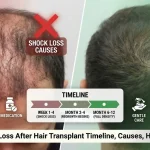
Between weeks 3 and 8 after your procedure, you will likely experience a phase where your newly transplanted hairs—and sometimes your original surrounding hairs—suddenly fall out. Do not panic.
This is a completely normal shedding phase known as shock loss. The hair shaft falls out, but the root (the follicle) remains safely embedded under the skin. Adhering to your prescribed Finasteride or Minoxidil routine (once cleared by your doctor) will help stimulate the dormant follicles and encourage the new growth phase to begin faster.
If you prefer not to use daily medications like Finasteride, or if you simply want to give your grafts an extra boost, clinical treatments are excellent alternatives.
For example, a hair PRP treatment (Platelet-Rich Plasma) utilizes the growth factors from your own blood to stimulate follicle repair and accelerate the healing of the donor area. Many premium packages include at least one session of PRP during the surgery.
Most surgeons recommend waiting until the initial healing phase is over (usually 7 to 14 days post-op) before resuming or starting Finasteride, to ensure your body focuses entirely on healing the incisions first. Always consult your specific surgeon for clearance.
No. Aspirin is a blood thinner. Taking it can increase the risk of bleeding from your newly implanted grafts or the donor area. You must only use the specific, non-blood-thinning painkillers provided by your clinic.
If you are using Minoxidil to maintain your original (non-transplanted) hair, yes, the results will fade if you stop using it. However, the transplanted hairs themselves are genetically resistant to DHT and will grow permanently even without medication.
Medications are just one piece of the puzzle. Achieving a dense, natural result requires patience and a strict adherence to your recovery timeline over the next 12 months. If you are looking for a clinic that provides a comprehensive medical kit and dedicated aftercare support, contact our team today for a free assessment.

You are just one step away from getting a completely free medical analysis.
Close windowWhich image best describes your current hair loss? Or use Voice Input.
Your age helps us determine the stability of your donor area.
At your age (18-23), hair loss is likely still progressing. We highly recommend preventative medical treatments.
Get Info on TreatmentsHave you ever had a hair transplant before?
Do you have any of the following health conditions?
Calculating graft density and hairline design.
Estimated Graft Need
🏆 Highly Recommended: VIP
We strongly recommend the VIP Package as it includes sedation/anesthesia, ensuring a completely comfortable and painless procedure.
📸 Please prepare these 3 photos for the doctor (Front Area, Top Crown, Back Donor):