



Understanding your hair transplant recovery timeline is one of the most important steps in your hair restoration journey. Knowing what to expect from week 1 to month 12 helps you monitor your progress safely and reduces unnecessary anxiety. For patients planning their procedure, understanding the recovery phases and the medical support provided in comprehensive Turkey hair transplant packages is essential for achieving a natural-looking, long-term result in 2026.
This guide focuses strictly on the long-term growth milestones. We will break down the recovery process into clear phases: the initial healing, the expected shedding phase, and the month-by-month maturation of your new hair. If you are still planning your travel schedule, you can also review our hair transplant Turkey 3-day journey guide to understand how the first wash and flight home are managed.
The first two weeks are critical for graft survival. During this period, the newly implanted follicles begin anchoring into the scalp’s blood supply. Your primary goal is to protect the grafts from physical trauma, friction, infection, and incorrect washing.
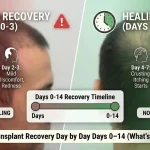
For a micro-level breakdown of the first two weeks, read our dedicated Days 0–14 recovery guide.
This is the phase that catches many patients off guard. Between weeks 3 and 8, the transplanted hair shafts may begin to fall out. Do not panic; this does not mean the transplant failed.
This physiological reaction is known as shock loss after hair transplant. The trauma of surgery can push follicles into a resting phase, known as telogen. While the visible hair shaft sheds, the vital hair root remains beneath the skin. During this time, your scalp may look similar to how it did before surgery. Patience is key during these weeks.
Once the resting phase concludes, the early growth stage begins. This stage can feel slow at first because new hairs often appear thin, uneven, and irregular before they mature.
You may start feeling fine, prickly hairs breaking through the scalp. Initially, these hairs may lack pigment and appear thin or wiry. Density will be low at this stage, which is normal. This is only the beginning of the growth cycle.
By month 6, many patients begin to see visible cosmetic improvement. Hair shafts start to thicken, darken, and align more naturally with the surrounding hair pattern.
The Medical Advantage: The quality of your growth during this phase depends heavily on surgical planning, graft handling, donor safety, and implantation angle. At HWT Clinic, the FUE hair transplant method is used strictly for extraction, helping harvest grafts without leaving a linear scar. For placement, the DHI hair transplant method can be used when suitable. Because DHI uses a Choi pen, doctors can control the depth, angle, and direction of each implanted follicle, helping the new hair blend naturally as it grows.
If you want to understand the technical difference between direct implantation and channel-opening methods, our DHI vs Sapphire FUE guide explains the comparison in more detail.
The second half of the first year is mainly about density, texture refinement, and styling flexibility.
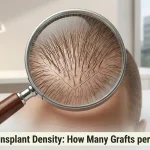
Natural-looking results are not only about waiting for growth. They also depend on how grafts were distributed from the beginning. Our guide on hair transplant density explains why coverage depends on graft placement, hair thickness, donor capacity, and blood supply rather than graft count alone.
If you had grafts implanted in the vertex, or crown, you must adjust your timeline. Due to thicker skin and a slightly different blood supply in this part of the scalp, the crown often takes longer to mature. It is normal for crown results to take up to 18 months to fully develop. Read more about this in our crown area hair transplant guide.
Understanding the difference between normal healing and potential complications is vital for a smooth recovery.
Usually Normal:
Not Normal: Contact your medical team if you notice:
For a broader overview of normal symptoms and warning signs, you can review our guide on hair transplant side effects. You should also follow your clinic’s instructions about activity limits, sun exposure, hats, alcohol, smoking, and exercise. Our things to avoid after hair transplant guide explains the most common mistakes patients should avoid during recovery.
You can typically trim the donor area, meaning the back and sides of your head, with clippers after 3 to 4 weeks. However, for the recipient area, or transplanted zone, scissors are usually preferred for the first 3 months to avoid unnecessary pressure or pulling on newly anchored roots. Always consult your clinic before your first haircut.
Uneven growth is normal during the early months. Hair follicles exit the resting phase and enter the growth phase at different times. Some grafts may sprout around month 3, while others may appear later. Density usually becomes more balanced as you approach the 8 to 10-month mark.
The overall biological timeline for hair growth remains the same regardless of technique. However, DHI may support a cleaner initial healing phase in suitable cases because it does not require pre-made channel incisions. This can mean less early trauma, bleeding, and scabbing compared with more invasive channel-opening approaches, but final growth still follows the natural hair cycle.

You are just one step away from getting a completely free medical analysis.
Close windowWhich image best describes your current hair loss? Or use Voice Input.
Your age helps us determine the stability of your donor area.
At your age (18-23), hair loss is likely still progressing. We highly recommend preventative medical treatments.
Get Info on TreatmentsHave you ever had a hair transplant before?
Do you have any of the following health conditions?
Calculating graft density and hairline design.
Estimated Graft Need
🏆 Highly Recommended: VIP
We strongly recommend the VIP Package as it includes sedation/anesthesia, ensuring a completely comfortable and painless procedure.
📸 Please prepare these 3 photos for the doctor (Front Area, Top Crown, Back Donor):