



One of the first questions every patient asks when considering a hair restoration procedure is, “How many grafts do I actually need?” The answer depends on your specific pattern of hair loss, the size of the balding area, your hair characteristics, and the safe limits of your donor supply. Understanding your stage on the Norwood Scale is the critical first step to accurately estimating the scope of your surgery and evaluating transparent Turkey hair transplant packages for 2026.
This comprehensive medical guide is focused exclusively on graft calculation and the Norwood Scale. We will break down exactly how many grafts are typically required for the hairline versus the crown, how doctors protect your long-term donor supply, and how to use graft estimates without falling for unrealistic “maximum graft” promises.
If you want a quick estimate while reading this guide, you can also use the floating Graft Calculator button on this page. It is a helpful starting point, but your final graft number should always be confirmed through a doctor-led assessment of your donor area, hair loss pattern, and target density.
The Norwood Scale, also known as the Hamilton-Norwood Scale, is the universal medical standard used by doctors to classify the severity of male pattern baldness, also called androgenetic alopecia. By identifying your exact stage, the surgical team can predict your future hair loss trajectory, determine whether you have sufficient donor hair, and calculate the approximate number of grafts needed for natural-looking coverage.
Below is a breakdown of the 7 stages of hair loss and the typical graft ranges required for a successful restoration. Keep in mind that 1 graft, also called a follicular unit, typically contains 1 to 4 individual hair strands.
Not all areas of the scalp require the same density. The frontal hairline dictates your facial symmetry and profile, meaning it requires careful single-hair graft placement to create a soft, natural transition.
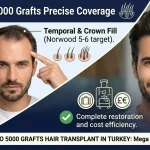
The crown, also called the vertex, is a graft-hungry zone. Because hair grows in a circular whorl pattern at the crown, light penetrates it easily. Covering a large bald spot on the crown can consume thousands of grafts. If you have limited donor supply, doctors often prioritize restoring the front and mid-scalp first. Read more about specific strategies for a crown area hair transplant.
This is also why graft planning should be based on both coverage and density. Our guide on hair transplant density explains why natural-looking results depend on distribution, angle, hair characteristics, and blood supply rather than simply placing the highest possible number of grafts.
Understanding how many grafts you need is only half the equation; how they are moved is what protects your safety and long-term result.
At HWT Clinic, we follow a two-phase clinical approach:
If you want to understand the difference between direct implantation and channel-opening techniques, our DHI vs Sapphire FUE comparison guide explains the technical distinction in more detail.
A high graft number is not automatically a better result. Clinics that promise unlimited grafts or quote the same number to every patient may be ignoring donor safety. This can lead to overharvesting, poor graft survival, visible scarring, and a permanently thinned donor area.
Before booking a procedure, make sure the clinic explains your estimated graft range, safe donor limit, hairline design, technique, and aftercare plan clearly. Our guide on hair transplant Turkey red flags explains which warning signs to avoid before paying a deposit.
No, this is generally medically unadvisable. The safe limit for a single daily session is typically around 4,500 to 5,000 grafts for suitable patients. Exceeding this limit can increase the time follicles spend outside the body, reduce survival rates, and increase the risk of overharvesting, donor damage, and scalp complications. If you need 7,000 grafts, it should usually be planned over two separate procedures spaced 10 to 12 months apart.
Some commercial clinics intentionally quote unrealistically high graft numbers to convince patients to book, often leading to donor damage. A legitimate, doctor-led clinic calculates graft needs based on your Norwood stage, hair thickness, donor density, safe extraction limits, future hair loss risk, and target coverage—not a sales pitch.
DHI is a meticulous implantation method using a Choi pen, which can take longer than traditional channel-opening methods. However, with an experienced medical team, suitable patients can still receive large sessions using DHI without compromising graft survival. The final number should always depend on donor safety, surgical time, graft handling, and medical suitability.



You are just one step away from getting a completely free medical analysis.
Close windowWhich image best describes your current hair loss? Or use Voice Input.
Your age helps us determine the stability of your donor area.
At your age (18-23), hair loss is likely still progressing. We highly recommend preventative medical treatments.
Get Info on TreatmentsHave you ever had a hair transplant before?
Do you have any of the following health conditions?
Calculating graft density and hairline design.
Estimated Graft Need
🏆 Highly Recommended: VIP
We strongly recommend the VIP Package as it includes sedation/anesthesia, ensuring a completely comfortable and painless procedure.
📸 Please prepare these 3 photos for the doctor (Front Area, Top Crown, Back Donor):