



One of the most common questions patients ask before booking surgery is whether the results will truly last. The short answer is that transplanted hair is designed to be long-lasting, but there are important medical details to understand. Patients traveling for a professional Turkey hair transplant need to understand the science behind graft survival, donor dominance, native hair loss, and long-term maintenance. In this guide, we explain why transplanted hair usually remains permanent and what you should do to protect the overall result over time.
A hair transplant is widely considered one of the most durable solutions for genetic hair loss. To understand why it works, we need to look at how hair follicles react to the hormones that cause male pattern baldness.
Male pattern baldness, also known as androgenetic alopecia, is strongly linked to a hormone called DHT, or dihydrotestosterone. In men who are genetically predisposed to hair loss, follicles on the top and front of the scalp are sensitive to DHT. Over time, these follicles miniaturize and produce thinner hair until growth becomes weaker.
However, the hair at the back and sides of the head, known as the donor area, is usually more resistant to DHT. When surgeons extract these resistant follicles and move them to thinning or bald areas, the follicles generally retain their original resistance. This principle is known as donor dominance.
This is why transplanted hairs can continue growing in their new location for many years. However, the result still depends on safe extraction, careful graft handling, correct placement, donor quality, and long-term planning.
While transplanted hair is usually resistant to male pattern baldness, the existing native hair on the top of your scalp may still be vulnerable to DHT.
If you are at an early stage on the Norwood Scale and still have a significant amount of original hair, that native hair may continue to thin over the next few years. This is why doctors often discuss long-term maintenance options, especially for younger patients or those with ongoing hair loss.
Using doctor-approved post-op medications such as Finasteride or Minoxidil may help slow further native hair loss in suitable patients. The goal is not only to protect the transplanted grafts, but also to preserve the surrounding hair so the result continues to look balanced over time.
If you are unsure how much hair loss may progress in the future, our guide on how many grafts you need explains how donor capacity, hair loss stage, and future planning are evaluated.
Permanent-looking results are not only about donor dominance. The surgical technique and medical planning also matter. At HWT Clinic, the process is separated into two key phases:
If you want to understand the difference between direct implantation and channel-opening methods, our DHI vs Sapphire FUE guide explains the comparison in more detail.
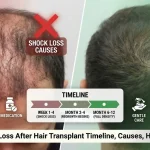
Many patients worry that their hair transplant is failing when the transplanted hair starts shedding a few weeks after surgery. In many cases, this is a normal part of the recovery process rather than permanent loss.
This early shedding phase is known as shock loss after hair transplant. The visible hair shaft sheds, but the follicle usually remains beneath the scalp. After a resting phase, new hairs often begin to appear around the third or fourth month, then continue maturing over the following months.
For a full month-by-month explanation of this process, review our hair transplant recovery timeline.
Although transplanted hair is usually resistant to DHT-related male pattern baldness, it is not completely separate from the natural aging process. As people get older, hair can become finer, lighter, or less dense-looking due to age-related changes.
Your transplanted hair will generally age like the hair from the donor area. The visual hair transplant density may appear softer in later years if individual hair shafts naturally become thinner with age.
This is why realistic density planning matters. A natural-looking result depends on donor capacity, hair thickness, graft distribution, blood supply, and future hair loss risk—not simply placing the highest possible number of grafts.
Transplanted hair follicles are usually taken from the DHT-resistant donor zone at the back and sides of the head. Because these follicles generally retain their resistance after being moved, they are expected to remain long-lasting and not fall out due to male pattern baldness. However, natural aging, health, donor quality, and surgical planning can still affect the final appearance over time.
It depends mostly on your native hair and future hair loss pattern. If you have surgery at a young age or continue losing non-transplanted hair after the procedure, a second touch-up procedure may be needed later to fill new thinning areas. This is why donor area management, realistic hairline design, and long-term medical planning are important.
Transplanted hairs usually do not fall out from male pattern baldness because they are taken from a more DHT-resistant donor area. However, hair can naturally become finer or lighter with age, and the surrounding native hair may continue to thin if it is not medically managed. If density changes years later, a doctor should evaluate whether the issue is native hair loss, aging, or another scalp condition.
A hair transplant can be a long-lasting investment when it is planned correctly and supported with proper aftercare. To make sure your result blends naturally with your future hair loss pattern, choose a clinic that prioritizes medical safety, donor management, and realistic long-term planning. Contact the expert medical team at HWT Clinic today for a free consultation and personalized restoration plan.



You are just one step away from getting a completely free medical analysis.
Close windowWhich image best describes your current hair loss? Or use Voice Input.
Your age helps us determine the stability of your donor area.
At your age (18-23), hair loss is likely still progressing. We highly recommend preventative medical treatments.
Get Info on TreatmentsHave you ever had a hair transplant before?
Do you have any of the following health conditions?
Calculating graft density and hairline design.
Estimated Graft Need
🏆 Highly Recommended: VIP
We strongly recommend the VIP Package as it includes sedation/anesthesia, ensuring a completely comfortable and painless procedure.
📸 Please prepare these 3 photos for the doctor (Front Area, Top Crown, Back Donor):