



A 3000 grafts hair transplant in Turkey is generally considered a mid-to-large session. It can be a strong option for patients who have moved beyond early thinning and need substantial coverage across the hairline, frontal third or selected areas of the mid-scalp.
When comparing Turkey hair transplant packages, the graft number should not be the only deciding factor. Safe extraction, long-term donor planning, graft quality and precise placement all influence how natural those 3,000 grafts will look.
This clinical guide focuses specifically on the 3,000 graft procedure. It explains how much coverage may be possible, which Norwood stages are commonly suitable, how the donor area is protected, what the procedure may cost in Turkey and what kind of result patients can realistically expect.
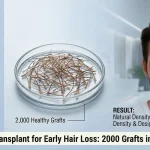
A graft is a naturally occurring follicular unit that may contain between one and four individual hairs. Depending on the proportion of single-, double-, triple- and four-hair follicular units, 3,000 grafts may represent roughly 6,000 to 7,500 individual hairs. This is an estimate rather than a guaranteed hair count.
Coverage depends on the size of the recipient area, the patient’s natural hair thickness, donor quality, scalp-to-hair colour contrast and the density required in each zone.
In a suitable patient, 3,000 grafts may commonly be used to:
However, 3,000 grafts will not always provide dense coverage across the hairline, mid-scalp and a large crown at the same time. When several zones are affected, the medical team may need to prioritise the areas that create the strongest visual improvement.
According to the Norwood Scale, 3,000 grafts are most commonly considered for patients around Norwood Stage 3 or Stage 4.
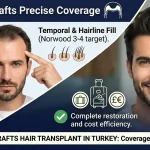
At Norwood Stage 3, 3,000 grafts may be enough to rebuild the hairline, restore the temples and provide meaningful density across the frontal third. Depending on the size of the head and the existing hair, limited mid-scalp coverage may also be possible.
At Norwood Stage 4, the frontal area and crown may both be affected. In many cases, 3,000 grafts are used primarily for the hairline and frontal third, with the remaining grafts distributed into the mid-scalp. Crown coverage will depend on the size of the vertex and the strength of the donor area.
If your hair loss is milder and mostly limited to the temples, a 2000 grafts hair transplant may be sufficient. For deeper frontal recession, our receding hairline transplant guide explains how the hairline and temple areas are planned.
Patients who are unsure about their stage can use our detailed how many grafts do I need guide as an initial reference. The final number should still be confirmed through a medical assessment of the recipient and donor areas.
The cost of a 3000 grafts hair transplant in Turkey is usually determined by the clinic, medical involvement, technique, package inclusions and aftercare rather than by graft count alone.
Some clinics charge per graft, while others use fixed treatment packages. At HWT Clinic, patients receive a fixed package price before travelling, without an additional per-graft charge when the approved medical plan requires approximately 3,000 grafts.
Silver: £1,399
Gold: £1,899
VIP: £2,199
The selected package determines the included accommodation, transfers, medication support and aftercare services. The medically appropriate graft number is confirmed after the patient’s photographs and donor capacity have been assessed.
For a full comparison of the wider Istanbul market, package inclusions and current HWT Clinic prices, review our main hair transplant cost in Turkey guide.
A successful 3,000 graft procedure can create a significant visual improvement, particularly when the grafts are concentrated in the hairline and frontal third. The result depends not only on the number of grafts but also on where they are placed and how effectively different follicular units are distributed.
Single-hair grafts are generally preferred along the front edge of the hairline to create a softer transition. Multi-hair grafts can then be placed behind this area to build stronger visual density.
Typical planning scenarios may include:
Two patients receiving the same number of grafts can have visibly different results. Hair calibre, curl, colour contrast, graft survival, recipient-area size and existing native hair all influence the final appearance.
Transplanted hair also develops gradually rather than immediately. Our hair transplant growth and recovery timeline explains what patients may experience during the first weeks and months after surgery.
Moving 3,000 grafts is a significant surgical procedure. At HWT Clinic, the treatment is separated into extraction and implantation phases to support graft survival, protect donor capacity and reduce unnecessary scalp trauma.
To collect the planned grafts, we use the FUE hair transplant method for extraction. FUE describes the removal of individual follicular units from the donor area; it is not, by itself, an implantation technique.
At HWT Clinic, motorised micro-punches are used to extract the planned grafts one by one. The extraction pattern is distributed across the safe donor area rather than concentrated in a small section.
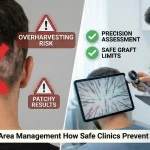
This careful donor area management helps reduce the risk of visible thinning, patchiness and overharvesting. Although 3,000 grafts may be feasible in one session for many suitable patients, donor density and long-term donor capacity must be assessed before confirming the plan.
For suitable patients, we use the DHI hair transplant method with implanter pens for the recipient area.
With sharp implanter placement, the recipient opening and graft insertion can be performed in the same step. This allows close control over the angle, direction and depth of each implanted follicular unit.
This precision is particularly important in the frontal zone, where natural hair transplant density depends on graft distribution, hairline irregularity, angle, donor quality and the number of hairs within each graft rather than graft count alone.
Patients who want to compare direct implanter placement with channel-opening techniques can read our DHI vs Sapphire FUE guide.
It depends on whether the crown is the only treatment area and how large the vertex has become. The crown is often described as a graft-demanding area because of its size and circular whorl pattern.
If hair loss is limited mainly to the crown, 3,000 grafts may provide strong coverage in a suitable patient. The final result will still depend on the crown’s surface area, hair thickness, donor quality and the density that can be created safely.
If the hairline, mid-scalp and crown are all significantly affected, 3,000 grafts will usually not be enough to restore every zone densely. In these cases, the doctor may recommend prioritising the frontal area and mid-scalp first.
A 4000 to 5000 grafts hair transplant may be considered for wider coverage when the donor area can safely support a larger session. Another option may be to divide the treatment into separate stages.
Our dedicated crown area hair transplant guide explains the biological and visual challenges involved in restoring the vertex.
At HWT Clinic, a 3,000 graft procedure typically takes approximately 6 to 8 hours. The exact duration can vary depending on extraction difficulty, donor quality, graft sorting, hairline design, scalp characteristics and the implantation plan.
The procedure is normally completed under local anaesthesia. Breaks may be provided during the day, particularly between the extraction and implantation phases.
Patients concerned about comfort can also review our guide explaining whether a hair transplant is painful and what usually happens during local anaesthesia.
Yes. A 3,000 graft procedure is generally classified as a mid-to-large session. It can provide enough volume to significantly improve a receding hairline and extend coverage into the frontal third or selected areas of the mid-scalp.
Usually not when the hairline, mid-scalp and a large crown are all affected. In advanced hair loss, the medical team may prioritise the frontal area or recommend a larger or staged procedure depending on donor capacity.
No. One graft may contain one, two, three or sometimes four hairs. Depending on the patient’s natural follicular-unit distribution, 3,000 grafts may represent approximately 6,000 to 7,500 individual hairs.
The price depends on the clinic, technique, medical involvement and package inclusions. At HWT Clinic, the procedure is covered by the selected fixed package rather than being charged separately per graft.
In a suitable patient, the donor area should not look noticeably thin when extraction is distributed carefully across the safe donor zone. However, the outcome depends on donor density, hair thickness, extraction pattern, previous procedures and future donor requirements.
At HWT Clinic, a 3,000 graft procedure typically takes approximately 6 to 8 hours. The exact duration depends on extraction difficulty, graft preparation, implantation technique, hairline design and the patient’s individual treatment plan.


You are just one step away from getting a completely free medical analysis.
Close windowWhich image best describes your current hair loss? Or use Voice Input.
Your age helps us determine the stability of your donor area.
At your age (18-23), hair loss is likely still progressing. We highly recommend preventative medical treatments.
Get Info on TreatmentsHave you ever had a hair transplant before?
Do you have any of the following health conditions?
Calculating graft density and hairline design.
Estimated Graft Need
🏆 Highly Recommended: VIP
We strongly recommend the VIP Package as it includes sedation/anesthesia, ensuring a completely comfortable and painless procedure.
📸 Please prepare these 3 photos for the doctor (Front Area, Top Crown, Back Donor):