



A curly hair transplant can be performed successfully, but the treatment requires careful donor assessment, adapted extraction planning and precise control of the direction in which each graft is implanted. Patients considering a professional hair transplant in Turkey should choose a medical team that understands that curly hair may also follow a curved path beneath the skin. This guide explains how wavy, curly and tightly coiled hair can affect graft extraction, density planning, costs and natural-looking results.
Quick answer: Yes, curly and wavy hair can be transplanted. The main challenge is that some curly follicles also curve beneath the surface of the scalp, which can increase the risk of damaging the graft during extraction. However, curl can provide strong visual coverage because the hairs overlap and create volume. Suitability depends on donor quality, the cause and pattern of hair loss, follicle curvature and realistic graft planning.
Yes. Naturally wavy, curly and tightly coiled hair can all be transplanted when the donor area is suitable and the treatment is planned according to the patient’s individual follicle structure.
The visible curl above the scalp is only one part of the assessment. In some patients, the follicle beneath the skin may also follow a curved path. The degree and direction of this curvature can vary between patients and even between different grafts within the same donor area.
This means a medical team should not assume that every curly-haired patient requires exactly the same punch size, extraction angle or implantation plan. The donor area must be examined carefully, and the extraction approach may need to be adjusted according to how the first grafts behave beneath the skin.
When these differences are respected, curly hair may provide an important visual advantage. Its natural shape can create greater overlap between neighbouring hairs, helping a carefully planned transplant look fuller without relying on an unnecessarily high graft number.
The terms wavy, curly and coily describe a wide range of hair patterns. They should not be treated as a single anatomical category.
| Hair Pattern | Extraction Consideration | Possible Visual Coverage |
|---|---|---|
| Wavy hair | The follicle may be relatively straight or show mild curvature beneath the skin. | The wave may provide more visual overlap than completely straight hair. |
| Curly hair | A more noticeable subcutaneous curve may require adapted punch direction and careful graft release. | Natural curl can create volume and reduce the amount of visible scalp. |
| Tightly coiled hair | Extraction may be more complex because the follicle can curve sharply beneath the surface. | Strong curl and hair calibre may create excellent visual coverage when grafts are distributed correctly. |
Hair type alone does not determine the final graft requirement. The medical team must also consider hair calibre, donor density, scalp-to-hair colour contrast, recipient-area size and the amount of native hair that remains.
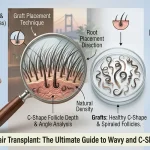
The main technical challenge is the part of the follicle that cannot be seen from the surface. An extraction punch enters the scalp according to the visible exit angle of the hair, but a curved follicle may change direction beneath the skin.
If the extraction path does not follow this hidden curve, the punch may cut across the follicular unit. This is known as transection. A damaged graft may not be suitable for implantation, which is why the extraction technique must be adapted rather than performed using a fixed approach for every patient.
Important considerations include:
Structured donor area management remains essential. Curly hair may hide mild donor thinning more effectively than straight hair, but this visual advantage should never be used to justify excessive or concentrated extraction.
Curly hair may sometimes create stronger visual coverage with the same number of grafts because each hair bends and overlaps with the hairs around it. However, this does not automatically mean that every curly-haired patient needs fewer grafts.
The required number still depends on:
For example, thick curly hair with low scalp contrast may create a fuller appearance than fine straight hair when the same number of grafts is implanted over an equal surface area. On the other hand, a patient with extensive hair loss may still need a large or staged procedure regardless of hair texture.
Natural-looking hair transplant density is therefore based on strategic graft distribution rather than the assumption that curl alone will compensate for an insufficient treatment plan.
A patient may be considered suitable when the donor area can provide healthy grafts and the cause and expected progression of the hair loss have been assessed.
Important suitability factors include:
The medical assessment should also consider previous hairstyles and grooming practices. Repeated tension from tight braids, extensions or similar styling can contribute to traction-related hair loss. In these cases, the stability of the affected area should be evaluated before transplantation is recommended.
Curly hair transplant is a broad term that can include wavy hair, loose curls and moderately curled follicular units. Afro-textured or tightly coiled hair represents a more specialised subgroup because the follicles may have stronger curvature beneath the skin.
Patients with tightly coiled Type 4 or Afro-textured hair may require additional consideration of donor curvature, graft fragility, skin characteristics, hairline design and the potential risk of raised scarring.
Because of these differences, Afro-textured cases should not be treated as identical to loose or moderately curly hair. Our dedicated Afro hair transplant page explains the specific planning considerations for tightly coiled hair in greater detail.
At HWT Clinic, the FUE hair transplant method is used to extract individual follicular grafts from the medically suitable donor area.
FUE describes the extraction stage of the procedure. It does not describe how the grafts will later be implanted into the recipient area.
For curly hair, punch size, angle and extraction direction are selected according to the patient’s donor characteristics. The medical team may assess the early extracted grafts and adapt the approach if the follicles show more curvature than expected.
The extraction pattern should remain evenly distributed. Removing grafts too closely from a small part of the donor area can create patchiness even when the total graft number appears reasonable.
Safe extraction is therefore not based on obtaining the highest possible number of grafts. The objective is to collect the medically approved grafts while protecting the appearance and long-term capacity of the donor area.
After extraction, the grafts must be implanted in a way that respects the patient’s existing hair direction, curl pattern and recipient-area design.
For medically suitable patients, the DHI hair transplant method may be used with implanter pens. DHI may provide close control over the angle, direction and depth of implantation.
This control can be useful when:
However, DHI is not automatically the best implantation method for every curly-haired patient. The correct technique depends on the size of the recipient area, the amount of native hair, graft characteristics and the doctor’s treatment plan.
Our DHI vs Sapphire FUE guide explains the differences between direct implanter placement and channel-opening approaches.
The cost of a curly hair transplant in Turkey depends on the required graft number, donor-area complexity, extraction difficulty, implantation method, medical involvement and the services included in the treatment package.
Curly hair does not automatically make a procedure more expensive, but a more technically demanding donor area may require additional planning and surgical time. The final treatment plan should therefore be confirmed after clear photographs and the donor area have been evaluated.
At HWT Clinic, the medically approved graft number is included within the selected fixed package rather than charged separately using a per-graft fee.
Silver: £1,399
Gold: £1,899
VIP: £2,199
The selected package determines the included accommodation, transfers, medication support and aftercare services. The final graft number is confirmed after the recipient area, donor capacity and follicle characteristics have been assessed.
A successful curly hair transplant can create strong visual improvement because the natural bends in the hair overlap and reduce the amount of visible scalp. However, the final result depends on more than curl alone.
Important factors include:
Before-and-after photographs should be compared under similar lighting, hair length, styling and camera angles. Curly hair can appear significantly fuller when grown longer or styled differently, so consistent photography is important when evaluating the true surgical result.
Transplanted grafts generally retain the characteristics of the donor hair. This means hair taken from a curly donor area will usually continue to grow with its natural curl pattern after transplantation.
The overall growth process is broadly similar to other hair transplant procedures. Some transplanted hair shafts may shed during the first weeks, followed by a resting period before new growth begins.
Early new hairs may appear fine, uneven or less curly than expected. As the hairs grow longer and mature, their thickness and natural texture may become more visible.
Patients commonly begin noticing early growth around the third or fourth month, with more substantial improvement developing during the following months. Final maturation may continue for approximately 12 months or longer depending on the individual and the treated area.
Our detailed hair transplant recovery timeline explains the general stages of shedding, early growth and maturation.
After the scalp has healed, curly hair may require a suitable moisturising and grooming routine because some textured hair types are naturally more prone to dryness and breakage. Patients should follow the clinic’s individual washing, product and aftercare instructions rather than applying heavy styling products too early.
Yes. Wavy, curly and tightly coiled hair can be transplanted successfully when the donor area is suitable. The extraction and implantation plan should be adapted to the patient’s follicle curvature, hair calibre, curl pattern and treatment goals.
Some curly follicles also curve beneath the surface of the scalp. This hidden curvature can increase the risk of cutting across the follicle during extraction. Punch selection, extraction direction and graft handling may therefore require additional care.
Transplanted hair generally retains the characteristics of the donor area. If the donor hair is naturally curly, the transplanted grafts will usually continue to grow with a similar curl pattern after they mature.
Not automatically. Curly hair may create stronger visual coverage because it bends and overlaps, but the required graft number still depends on the size of the treatment area, donor capacity, hair calibre, existing native hair and the desired density.
FUE may be suitable for curly hair when the extraction method is adapted to the donor characteristics. The medical team must consider the follicle’s path beneath the skin and adjust punch selection, angle and extraction direction when necessary.
The price depends on the graft requirement, donor complexity, medical involvement, implantation method and package inclusions. At HWT Clinic, the medically approved graft plan is included within the selected fixed package rather than charged separately per graft.
Early growth may begin around the third or fourth month, with more noticeable improvement developing during the following months. The transplanted hair may continue to thicken and mature for approximately 12 months or longer, depending on the individual and the treated area.
A successful curly hair transplant depends on accurate donor assessment, careful extraction and a recipient-area design that respects the patient’s natural curl direction. The objective is not simply to move the highest possible number of grafts, but to create balanced visual coverage while protecting the donor area and preserving future treatment options.


You are just one step away from getting a completely free medical analysis.
Close windowWhich image best describes your current hair loss? Or use Voice Input.
Your age helps us determine the stability of your donor area.
At your age (18-23), hair loss is likely still progressing. We highly recommend preventative medical treatments.
Get Info on TreatmentsHave you ever had a hair transplant before?
Do you have any of the following health conditions?
Calculating graft density and hairline design.
Estimated Graft Need
🏆 Highly Recommended: VIP
We strongly recommend the VIP Package as it includes sedation/anesthesia, ensuring a completely comfortable and painless procedure.
📸 Please prepare these 3 photos for the doctor (Front Area, Top Crown, Back Donor):