



A failed hair transplant can be a devastating and stressful experience. Some results can be improved with a carefully planned revision procedure, while others may only be partially corrected because donor hair is limited and previous surgery may have caused scarring or permanent damage.
When considering revision surgery, understanding the medical standards behind a hair transplant in Turkey can help you evaluate whether a proposed repair plan is safe, realistic and suitable for your long-term hair loss pattern.
This guide focuses strictly on failed hair transplant repair: when a result can genuinely be considered unsuccessful, why procedures fail, which problems may be corrected and how HWT Clinic evaluates revision cases using FUE extraction and DHI implantation when medically suitable.
Quick answer: A failed hair transplant can often be improved, but the correct solution depends on the type of failure. Some patients need additional density, while others may require hairline redesign, selected graft removal, scar camouflage, donor-area management or a staged repair plan.
A hair transplant should not usually be judged during the first few months. Temporary shedding, redness, short hair length and uneven early growth can make a normal recovery look unsuccessful before the transplanted follicles have had enough time to mature.
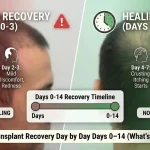
In many cases, the cosmetic result is assessed after approximately 10 to 12 months. Crown growth may take longer in some patients because this area can mature more slowly than the frontal hairline or mid-scalp. If you are still within the early recovery period, review our hair transplant recovery timeline before assuming that the procedure has failed.
However, patients should not wait 10 months before seeking medical advice if they experience severe pain, signs of infection, skin necrosis, worsening inflammation, unusual discharge or rapidly developing scar tissue. Early complications and the final cosmetic result are different issues and should be evaluated separately.
If the normal maturation period has passed, the following findings may justify a specialised repair assessment:
If you are unsure whether your symptoms are part of normal healing or indicate a complication, review our guide to hair transplant side effects.
Failed outcomes may result from poor planning, weak donor management, graft trauma, inappropriate patient selection or incorrect placement. High-volume clinics that focus primarily on completing many procedures each day may also fail to provide the individual planning required for complex hair loss patterns. Our 17 red flags in Turkey hair transplant checklist explains warning signs patients should evaluate before booking surgery.
An age-appropriate hairline requires careful consideration of facial proportions, future hair loss, donor capacity and the patient’s natural hair direction. Hairlines that are positioned too low, designed as perfectly straight lines or created with multi-hair grafts in the front row can look artificial even when the grafts grow successfully.
The donor area is a limited lifetime resource. There is no universal number of grafts that can be safely extracted from every patient. Available capacity depends on follicular density, hair thickness, the size of the stable donor zone, miniaturisation, previous operations and the amount of reserve required for future hair loss.
Overharvesting can occur when too many grafts are removed or when extractions are concentrated within small sections. Proper donor area management is therefore essential before both an initial transplant and a repair procedure.
Poor graft growth cannot normally be explained by the procedure name alone. Possible contributing factors include extraction trauma, graft handling, excessive time outside the body, unsuitable storage, recipient-site planning, implantation trauma, reduced blood supply, infection and aftercare problems.
FUE hair transplant describes the individual extraction of follicular grafts from the donor area. It does not describe how the grafts are later implanted. For suitable repair cases, DHI hair transplant with implanter pens may allow controlled placement between existing hairs, but no implantation tool can guarantee graft survival or correct every previous surgical problem.
Our DHI vs Sapphire FUE guide explains the distinction between extraction and implantation methods in greater detail.
A repair plan should be based on the specific problem rather than simply adding more grafts. Different types of failure require different corrective strategies.
| Problem | What Must Be Assessed? | Possible Repair Approach |
|---|---|---|
| Low density or poor growth | Remaining donor capacity, scar tissue, blood supply and existing graft distribution. | Additional grafts and improved distribution when medically suitable. |
| Pluggy or excessively low hairline | Hairline position, graft size, angles and available space. | Single-hair softening, selected graft removal or staged redesign. |
| Incorrect angles and direction | Exit angle, hair calibre and the direction of surrounding native hair. | Camouflage, selected graft removal or careful reimplantation. |
| Overharvested donor area | Residual density, extraction distribution, scarring and donor stability. | Longer hairstyle, SMP, limited grafting or beard/body hair in selected cases. |
| FUE or FUT scarring | Scar type, width, skin quality, blood supply and surrounding density. | Scar grafting, scalp micropigmentation or selected scar revision. |
| Continued native hair loss | Current loss pattern, age, family history and donor reserve. | Long-term medical and surgical planning rather than isolated density filling. |
Repair surgery must be customised according to the type of failure, remaining donor capacity and condition of the recipient area. Adding more grafts is only one possible option.
If the first transplant produced weak coverage, an additional procedure may improve density when sufficient donor capacity and recipient blood supply remain. Before approving more grafts, the medical team should assess whether the poor appearance is caused by low graft survival, inadequate distribution, continued native hair loss or unrealistic original expectations.
Our guide on how many grafts you need explains how the recipient area and donor supply are evaluated. Density should be planned conservatively in revision cases. The aim is to create balanced visual coverage without placing excessive pressure on the donor area or scarred recipient tissue.
Our guide to hair transplant density explains why hair calibre, scalp contrast, graft distribution and blood supply can be as important as the total graft number.
A harsh or pluggy frontal hairline may sometimes be softened by placing carefully selected single-hair grafts around the existing line. However, simply adding more hair in front of an already low hairline may make the problem worse.
When the hairline is excessively low or contains large, incorrectly positioned grafts, selected grafts may need to be removed, reduced or reimplanted. Patients with older plug-style results can also review our guide to hair plugs and modern correction options.
Incorrectly angled grafts are among the most difficult problems to repair. New grafts cannot always conceal hairs that grow vertically or against the natural direction of the surrounding hair.
Depending on the severity of the problem, correction may involve placing new grafts at more natural angles, removing selected poorly directed follicles or completing the repair in several stages. The strategy must consider the thickness, location and visibility of the existing grafts.
Follicles that have been completely extracted from the donor area do not grow back in the same location. For this reason, true donor depletion cannot normally be fully reversed.
Possible management options may include growing the surrounding hair longer, using scalp micropigmentation to reduce scalp contrast, redistributing a limited number of remaining grafts or considering body hair transplant methods in selected patients.
Beard or body grafts do not behave exactly like scalp hair and are not suitable for every repair. Their texture, growth cycle, colour and calibre must be considered before they are included in a corrective plan.
Previous FUE extraction may leave visible white-dot patterns, particularly after aggressive or concentrated harvesting. FUT surgery can leave a linear scar at the back of the scalp. Recipient areas may also develop irregular scar tissue after poor healing, infection or excessive trauma.
Possible scar-management options include carefully placing grafts into or around the affected area, scalp micropigmentation or selected scar-revision procedures. Graft survival can be less predictable within scar tissue because the blood supply may differ from normal scalp tissue. The density target must therefore remain realistic.
A second procedure should not be approved only because the patient is unhappy with the first result. A proper assessment should review:
Photographs can provide an initial indication, but the final graft number and repair plan should normally be confirmed after an in-person examination of the donor and recipient areas.
Some mild density problems may be improved in one additional session. More complex cases can require a staged approach.
An excessively low or pluggy hairline may first require selected graft removal before new single-hair grafts can be placed. Scar repair may also require conservative density and more than one procedure. In donor-damage cases, complete restoration may not be possible even after multiple treatments.
The number of sessions should therefore be based on medical necessity, donor limitations and the safest order of correction rather than the patient’s preferred timeline.
Before travelling for repair surgery, patients should provide enough information for a meaningful preliminary assessment. Useful information includes:
The initial photo assessment can help identify possible repair options, but it should not be treated as a guaranteed final surgical plan. Donor capacity, scar tissue and the direction of existing grafts may need to be examined closely at the clinic before the final procedure is confirmed.
Many patients contact HWT Clinic after receiving disappointing results from previous procedures. Chase, a patient from the USA, describes his own experience with an earlier transplant and his decision to undergo a second procedure at HWT Clinic to improve his frontal hairline and crown.
This video represents one patient’s individual experience. Repair results vary according to the original procedure, remaining donor capacity, hair characteristics, scarring and the corrective plan. The same outcome cannot be guaranteed for every patient.
Repair surgery is generally more complex than a first hair transplant because the donor supply may already be reduced and the recipient area may contain scar tissue, incorrectly angled grafts or disrupted blood supply.
Important limitations include:
A responsible repair plan should explain both what can be improved and what may remain visible after treatment.
Corrective procedures require careful medical planning and should not be approached as a standard repeat transplant. Before choosing a clinic, ask:
If you are still comparing clinics, our guide on how to choose a hair transplant clinic in Turkey explains how to evaluate medical standards, doctor involvement, pricing transparency and aftercare before committing to a revision procedure.
For an initial assessment, send our medical team clear photographs of your frontal hairline, top, crown and donor area together with the date of your first operation, estimated graft number and main concern.
Contact our team via WhatsApp and request a personalised hair transplant repair review.
Most cosmetic results should be assessed after approximately 10 to 12 months. Crown growth may take longer in some patients. However, severe pain, infection, necrosis, unusual discharge or rapidly worsening symptoms should be medically evaluated immediately rather than waiting for the final growth period.
The timing of revision surgery depends on scalp healing, scar maturity and the type of correction required. Although many repairs are planned after the original result has matured, graft removal, scar treatment and staged hairline correction may follow different timelines. The final timing should be decided after medical assessment.
DHI implantation may help place new single-hair grafts at controlled angles in suitable cases. However, an excessively low, pluggy or incorrectly angled hairline may also require selected graft removal or a staged redesign. The implantation method alone cannot correct every problem.
Some incorrectly angled grafts can be camouflaged with carefully placed new follicles. More visible or severely misdirected grafts may need to be removed, reduced or reimplanted. The treatment depends on their location, angle, thickness and relationship with the surrounding hair.
This cannot be determined from the original graft number alone. Doctors must assess the remaining density, hair calibre, extraction distribution, miniaturisation, scarring and the size of the stable donor zone. Some patients may still support a limited repair, while others may need non-surgical camouflage options.
Follicles that have been fully extracted do not grow back in the same location. Temporary shock loss may improve, but permanent donor depletion cannot usually be reversed completely. Longer hairstyles, scalp micropigmentation and selected repair procedures may help reduce its visibility.
Some scars can be improved with carefully planned graft placement, scalp micropigmentation or selected scar-revision procedures. Suitability depends on the scar type, width, skin condition, blood supply and available donor hair.
No. Mild density correction may be possible in one session, while pluggy hairlines, graft removal, major scarring or extensive donor damage may require staged treatment. The safest plan should be determined after a complete donor and recipient-area assessment.


You are just one step away from getting a completely free medical analysis.
Close windowWhich image best describes your current hair loss? Or use Voice Input.
Your age helps us determine the stability of your donor area.
At your age (18-23), hair loss is likely still progressing. We highly recommend preventative medical treatments.
Get Info on TreatmentsHave you ever had a hair transplant before?
Do you have any of the following health conditions?
Calculating graft density and hairline design.
Estimated Graft Need
🏆 Highly Recommended: VIP
We strongly recommend the VIP Package as it includes sedation/anesthesia, ensuring a completely comfortable and painless procedure.
📸 Please prepare these 3 photos for the doctor (Front Area, Top Crown, Back Donor):