



Stem cell treatment for hair loss is a supportive regenerative approach that is often discussed in modern hair restoration. It aims to use biologically active cells or cell-derived factors to support scalp healing, follicle activity, and hair quality in suitable patients. For people researching hair restoration in Turkey, it is important to understand that stem cell-based treatments are not the same as a standard hair transplant and should not be presented as a guaranteed cure for baldness.
This guide explains what stem cell hair treatment is, how it may work, who may be suitable, what its limitations are, how it compares with PRP and hair transplant surgery, and why a doctor-led diagnosis is essential before choosing any treatment.
Stem cell hair treatment is a medical approach that uses cells or biologically active material taken from the patient’s own body to support the scalp and hair follicles. Depending on the protocol, material may be collected from areas such as scalp tissue, fat tissue, or other approved sources, then processed and applied to areas of thinning hair.
The goal is usually to support weak follicles, improve the scalp environment, and help existing hair perform better. However, stem cell treatment should not be confused with a traditional hair transplant. A hair transplant physically moves healthy follicles from the donor area to bald areas, while stem cell treatment is generally considered a supportive or regenerative option.
If you are comparing non-surgical and surgical options, our guide on hair loss treatments for men explains how medications, PRP, lifestyle changes, and surgery fit into a broader treatment plan.
The function of stem cell-based hair treatment is to support the biological environment around the hair follicles. In theory, this may help improve tissue repair, scalp quality, and follicle activity in selected patients.
Hair loss can be caused by genetics, hormones, illness, nutritional deficiency, scalp inflammation, medication use, or stress. Because the cause matters, stem cell treatment should not be used blindly. Before choosing any regenerative treatment, patients should first understand the reason behind their hair loss. You can review our guides on causes of hair loss and illnesses that cause hair loss.
The exact process depends on the clinic’s medical protocol, the material used, and the patient’s diagnosis. In general, the process may include collection, processing, preparation, and application to the scalp.
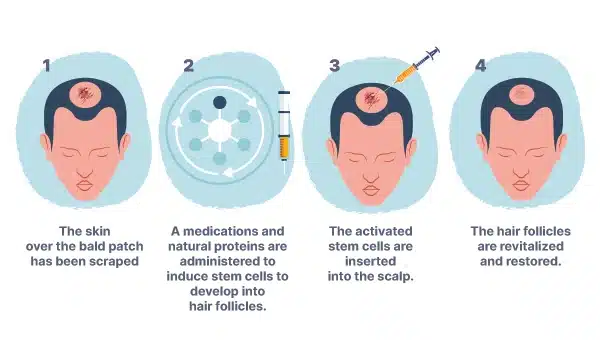
Stem cell-based hair treatment is less standardized than established treatments such as hair transplantation, PRP, Minoxidil, or Finasteride. Protocols can vary significantly between clinics, and the evidence base is still developing.
This is why patients should be cautious of clinics that advertise stem cell treatment as a guaranteed cure for baldness. A responsible clinic should explain what the treatment can realistically do, what it cannot do, how many sessions may be needed, what results can be expected, and whether surgery would be more appropriate.
Stem cell treatment may be considered in selected patients with thinning hair, weak follicles, or early-stage hair loss where some follicle activity still exists. It may also be discussed as a supportive treatment alongside PRP, medication, or surgery in suitable cases.
It is usually less suitable as a stand-alone solution for fully bald areas where follicles are no longer active. In those cases, a surgical approach such as FUE hair transplant extraction followed by DHI hair transplant implantation may be more appropriate, depending on donor capacity and medical suitability.
Suitability depends on diagnosis, scalp health, medical history, medications, hair loss stage, and realistic expectations. A doctor-led consultation is necessary before treatment.
If your hair loss is already advanced, the first step is usually to calculate your hair loss stage and donor capacity. Our guides on Norwood Scale and how many grafts you need can help you understand when surgery becomes more realistic.
Many regenerative hair treatments use material taken from the patient’s own body. This is called an autologous approach. Using the patient’s own material may reduce certain compatibility concerns, but it does not make the treatment risk-free or guaranteed.
Patients should always ask what exactly is being collected, how it is processed, what equipment is used, what medical standards are followed, and whether the treatment is appropriate for their diagnosis.
The possible benefits vary from patient to patient. Stem cell treatment should be explained as a supportive option, not as a guaranteed hair regrowth solution.
For comparison, hair PRP treatment is another supportive regenerative option that uses platelet-rich plasma from the patient’s own blood. PRP and stem cell treatment are often discussed together, but they are not the same.
Patients with different hair loss patterns may ask about stem cell treatment, but the expected benefit depends heavily on the cause and stage of hair loss.
Male pattern baldness, also called androgenetic alopecia, usually appears as a receding hairline, temple recession, crown thinning, or thinning across the top of the scalp. Stem cell treatment may support weak follicles in early stages, but it is not usually enough to restore fully bald areas.
For established baldness, a hair transplant may be more realistic. Our guide on whether a hair transplant is permanent explains why transplanted hairs are usually more resistant to male pattern baldness.
Female pattern hair loss often appears as diffuse thinning across the scalp rather than a sharply receding hairline. Before considering any regenerative treatment, women should be evaluated for hormonal factors, iron deficiency, thyroid issues, stress, postpartum shedding, and other medical causes.
Cicatricial alopecia, also called scarring alopecia, is a group of inflammatory conditions that can permanently damage hair follicles. These cases require careful medical diagnosis and should not be treated with cosmetic procedures alone while inflammation is active.
If scarring alopecia or another medical hair loss condition is suspected, the priority should be diagnosis and disease control before considering any transplant or regenerative treatment.
Any procedure involving injections, tissue collection, or scalp application can have side effects. These may include:
If you experience severe pain, pus, fever, strong odor, heavy bleeding, or worsening swelling, contact your medical team. For a broader understanding of normal and abnormal symptoms after hair procedures, review our guide on hair transplant side effects.
The cost of stem cell hair treatment varies depending on the country, clinic, doctor experience, preparation method, number of sessions, and whether it is combined with PRP or hair transplant surgery.
Patients should be cautious when comparing prices because stem cell protocols are not always standardized. Instead of focusing only on cost, ask what the treatment includes, what evidence supports the protocol, who performs the procedure, what risks exist, and whether it is the right choice for your type of hair loss.
If your main question is surgical cost, graft number, hotel, transfers, and aftercare, review our Turkey hair transplant packages guide.
Patients should expect a consultation, medical evaluation, possible blood tests or scalp examination, treatment planning, the procedure itself, and follow-up monitoring. The session duration and recovery time depend on the protocol used.
Visible changes, if they occur, are gradual. Hair-related treatments usually take months to show visible improvement because hair growth follows a biological cycle. If you recently had a hair transplant, the month-by-month process is explained in our hair transplant recovery timeline.
Preparation should always be based on your doctor’s instructions. General preparation may include:
After treatment, follow your doctor’s instructions carefully. You may be advised to avoid strenuous activity, direct sun exposure, harsh hair products, alcohol, smoking, or scalp irritation for a short period.
If the treatment is performed after a hair transplant, it should fit into your wider recovery plan. Our guides on post-op medications after hair transplant, things to avoid after hair transplant, and shock loss after hair transplant explain common recovery concerns.
Because stem cell hair treatment is not as standardized as traditional hair transplant surgery, clinic selection matters. Avoid clinics that promise guaranteed regrowth, permanent cure, or dramatic results without diagnosis.
Before choosing a clinic, ask:
If you are comparing clinics in Turkey, our hair transplant Turkey red flags guide can help you avoid unsafe providers and unrealistic claims.
Stem cell hair treatment may help support follicle activity and scalp health in selected patients, but results vary and it should not be presented as a guaranteed cure for baldness. Its effectiveness depends on diagnosis, hair loss stage, treatment protocol, and individual response.
Stem cells are being studied for their potential role in hair follicle biology and regenerative medicine. Some patients may see improvement in hair quality or thinning areas, but stem cell treatment does not reliably regrow a full head of hair in advanced baldness. A doctor should assess whether regenerative treatment, PRP, medication, or surgery is more appropriate.
Usually, no. Stem cell treatment may support weak follicles where hair still exists, but it does not physically move new follicles into bald areas. If an area has already lost significant density, a hair transplant may be the more realistic option, provided donor capacity is sufficient.
Stem cell treatment results are not guaranteed to be permanent and may require maintenance or combination therapy. Long-term results depend on the cause of hair loss, ongoing hair miniaturization, scalp health, and whether the patient follows a doctor-led plan.


You are just one step away from getting a completely free medical analysis.
Close windowWhich image best describes your current hair loss? Or use Voice Input.
Your age helps us determine the stability of your donor area.
At your age (18-23), hair loss is likely still progressing. We highly recommend preventative medical treatments.
Get Info on TreatmentsHave you ever had a hair transplant before?
Do you have any of the following health conditions?
Calculating graft density and hairline design.
Estimated Graft Need
🏆 Highly Recommended: VIP
We strongly recommend the VIP Package as it includes sedation/anesthesia, ensuring a completely comfortable and painless procedure.
📸 Please prepare these 3 photos for the doctor (Front Area, Top Crown, Back Donor):