



If you, or someone you know, has been affected by male pattern baldness or hair loss, you may have heard of the Norwood Scale, also known as the Hamilton-Norwood Scale. Identifying your likely stage is an important first step when estimating your hair transplant cost by graft count and planning a safe restoration journey for 2026.
In simple terms, Norwood Stages 1 and 2 represent little or early recession, Stages 3 and 4 indicate clinically visible hair loss, and Stages 5 to 7 describe more advanced patterns involving the frontal area, mid-scalp and crown.
The system was named after Dr. James Hamilton, who first developed the classification in 1951, and Dr. O’Tar Norwood, who expanded it in the 1970s. Today, the Hamilton-Norwood Scale remains one of the most widely used clinical systems for grading the visible progression of male pattern hair loss, also known as androgenetic alopecia.
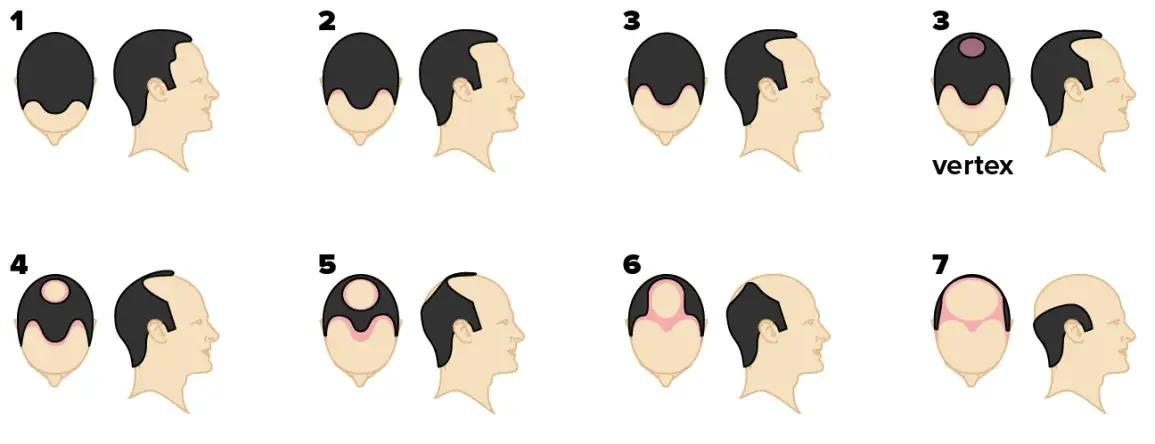
The Norwood hair scale is used to describe the visible progression of male pattern baldness. At HWT Clinic, our doctors use this scale alongside your medical history, donor capacity, age, genetics and future hair loss risk to assess whether you may be suitable for hair transplant surgery.
Knowing your stage gives doctors a shared point of reference when assessing your current pattern and likely future progression. It may also help determine whether one or more treatment stages should be considered, the likely graft range and whether a natural-looking result can be planned without exhausting the donor area.
However, the Norwood stage does not provide a complete treatment plan on its own. Two patients at the same stage may need very different strategies depending on their head size, hair thickness, donor density, scalp contrast and the areas they want to restore.
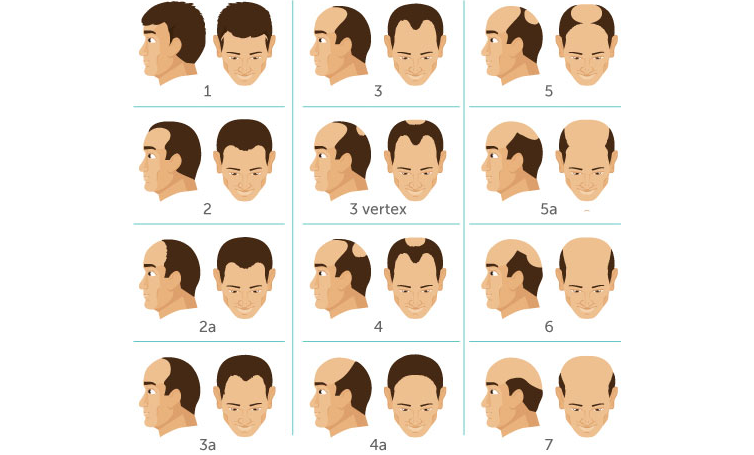
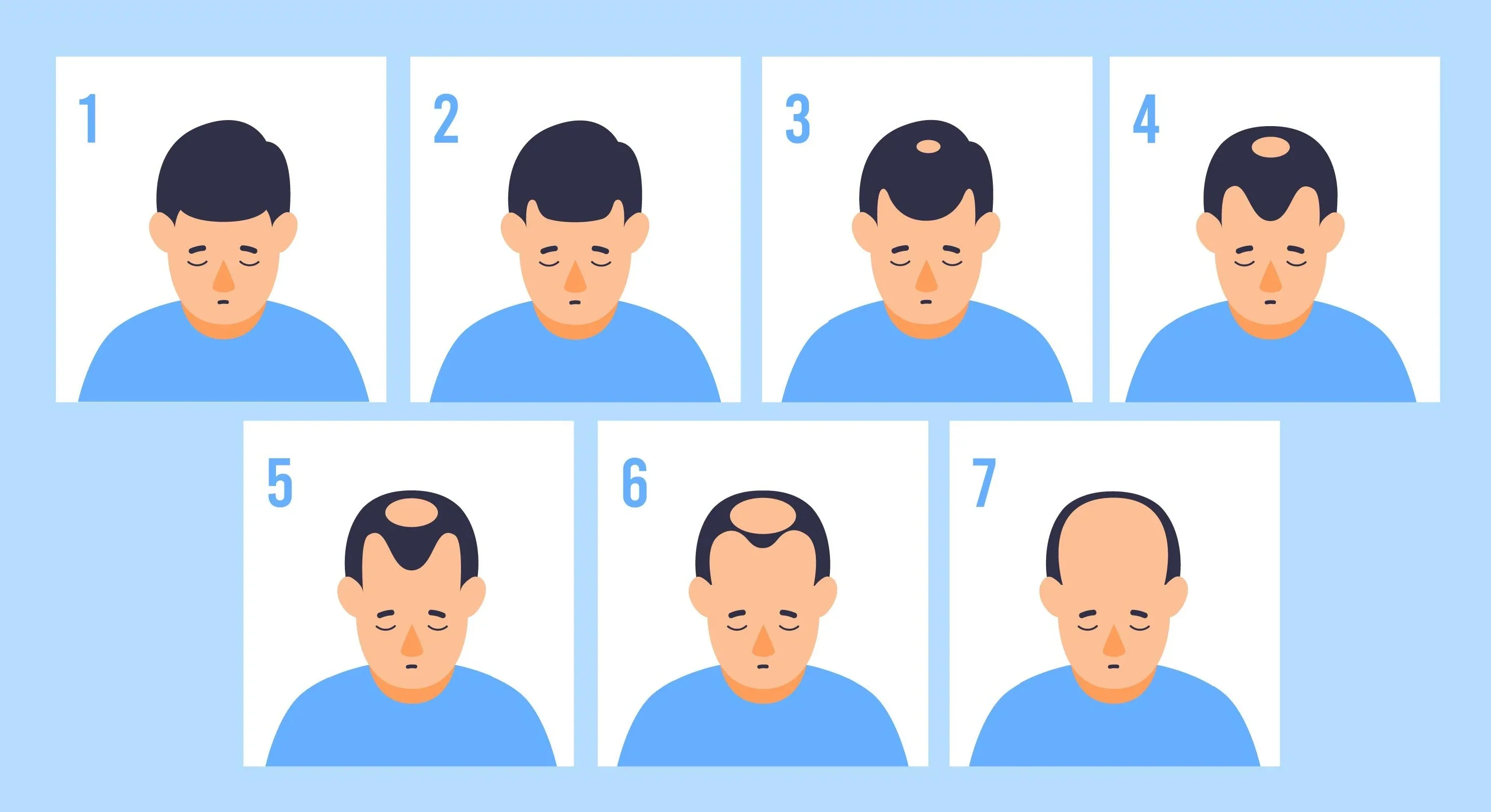
There are seven primary stages on the Norwood hair loss scale. Each stage describes a different pattern and may require a different medical or surgical strategy.
For early recession, a 2000 grafts hair transplant may be enough for targeted hairline or temple restoration. For a wider Stage 3 or early Stage 4 pattern, a 3000 grafts hair transplant may be considered to improve frontal coverage and create a natural-looking transition into the existing hair.
Norwood 4–5 is an informal description used by patients whose pattern appears to fall between Stage 4 and Stage 5. The frontal recession and crown loss are both clearly visible, while the bridge of hair separating them has started to become thinner.
Surgical planning at this stage usually requires prioritisation. Doctors may focus first on the frontal third and mid-scalp because trying to create full density across the hairline, mid-scalp and crown could require more grafts than the donor area can safely provide.
Advanced hair loss requires a specialised strategy. Learn how surgical teams plan a 4000 to 5000 grafts mega session while protecting the donor area and prioritising the zones that create the strongest visual improvement.
Progression through the Norwood stages depends on genetics, hormones, age and the long-term stability of the donor area. Hair loss does not always progress at the same speed, and not every patient will reach an advanced stage.
If your hair loss has reached Stage 3 or beyond, surgery may be considered after a doctor-led assessment. Many international patients choose Istanbul because larger graft procedures can be more affordable than in the UK or US, but safe donor management and realistic coverage should always take priority over the highest possible graft number.
The following figures are broad planning ranges commonly associated with each stage. They should not be interpreted as a fixed quotation or surgical recommendation.
| Norwood Stage | Typical Graft Count | Common Treatment Area |
|---|---|---|
| NW 2 | 800–1,500 grafts | Temples or limited hairline refinement |
| NW 3 | 1,500–3,000 grafts | Hairline, temples or a limited vertex area |
| NW 4 | 2,500–4,000 grafts | Frontal third, mid-scalp and selected crown coverage |
| NW 5+ | 4,000–5,000+ grafts | Prioritised frontal and mid-scalp coverage, with crown planning where donor supply allows |
These are broad planning ranges, not fixed recommendations. Two patients at the same Norwood stage may require different graft counts because of head size, hair thickness, donor density, scalp contrast, existing miniaturised hair and the areas selected for treatment.
Your Norwood stage is only one part of the planning process. Doctors also evaluate donor capacity, hair thickness, scalp contrast, future hair loss risk, existing miniaturised hair and the level of density that can be achieved safely.
Our detailed guide on how many grafts you need explains how these factors are combined to estimate a realistic graft range without relying on the Norwood stage alone.
At earlier stages, treatment may focus mainly on the temples and frontal hairline. At more advanced stages, the available grafts may need to be distributed across the frontal third, mid-scalp and crown. In these cases, creating the strongest visual improvement is often more realistic than attempting the same density across every thinning area.
For patients with crown thinning, graft planning becomes more complex because the crown can consume a large number of grafts due to its size and circular growth pattern. You can read more in our crown area hair transplant guide.
Safe surgery also depends on technique. The FUE hair transplant method can be used to extract individual follicular units, while the DHI hair transplant method may be used for direct implantation when clinically suitable.
Proper donor area management helps protect the patient’s limited donor supply, while careful hair transplant density planning helps create natural coverage without overharvesting the donor area or placing an unrealistic number of grafts into the recipient area.
Front, side, top, crown and donor-area photographs can provide an initial indication of your likely Norwood stage. Clear images allow the medical team to see where the hairline has receded, whether the crown is affected and how much permanent hair may be available around the sides and back.
However, photographs alone cannot fully confirm donor strength, active miniaturisation or how quickly the hair loss is progressing. A doctor-led assessment should combine the visible pattern with your age, medical history, family history, previous treatments and donor capacity.
This is also why an online Norwood scale calculator or visual chart should be treated only as an initial reference. The same visible stage can lead to different treatment plans for different patients.
The Norwood Scale was designed primarily to describe male pattern hair loss. Women more commonly experience diffuse thinning across the top of the scalp rather than the same temple-to-crown progression usually seen in men.
Female pattern hair loss may therefore be described using other classification systems, such as the Ludwig or Savin scale, alongside a medical assessment. Women experiencing sudden, patchy or rapidly progressing hair loss should be medically evaluated before considering surgery.
Ready to understand your likely Norwood stage? Contact our medical team via WhatsApp for a free photo analysis and receive a personalised assessment based on your hair loss pattern, donor area and restoration goals.





You are just one step away from getting a completely free medical analysis.
Close windowWhich image best describes your current hair loss? Or use Voice Input.
Your age helps us determine the stability of your donor area.
At your age (18-23), hair loss is likely still progressing. We highly recommend preventative medical treatments.
Get Info on TreatmentsHave you ever had a hair transplant before?
Do you have any of the following health conditions?
Calculating graft density and hairline design.
Estimated Graft Need
🏆 Highly Recommended: VIP
We strongly recommend the VIP Package as it includes sedation/anesthesia, ensuring a completely comfortable and painless procedure.
📸 Please prepare these 3 photos for the doctor (Front Area, Top Crown, Back Donor):