

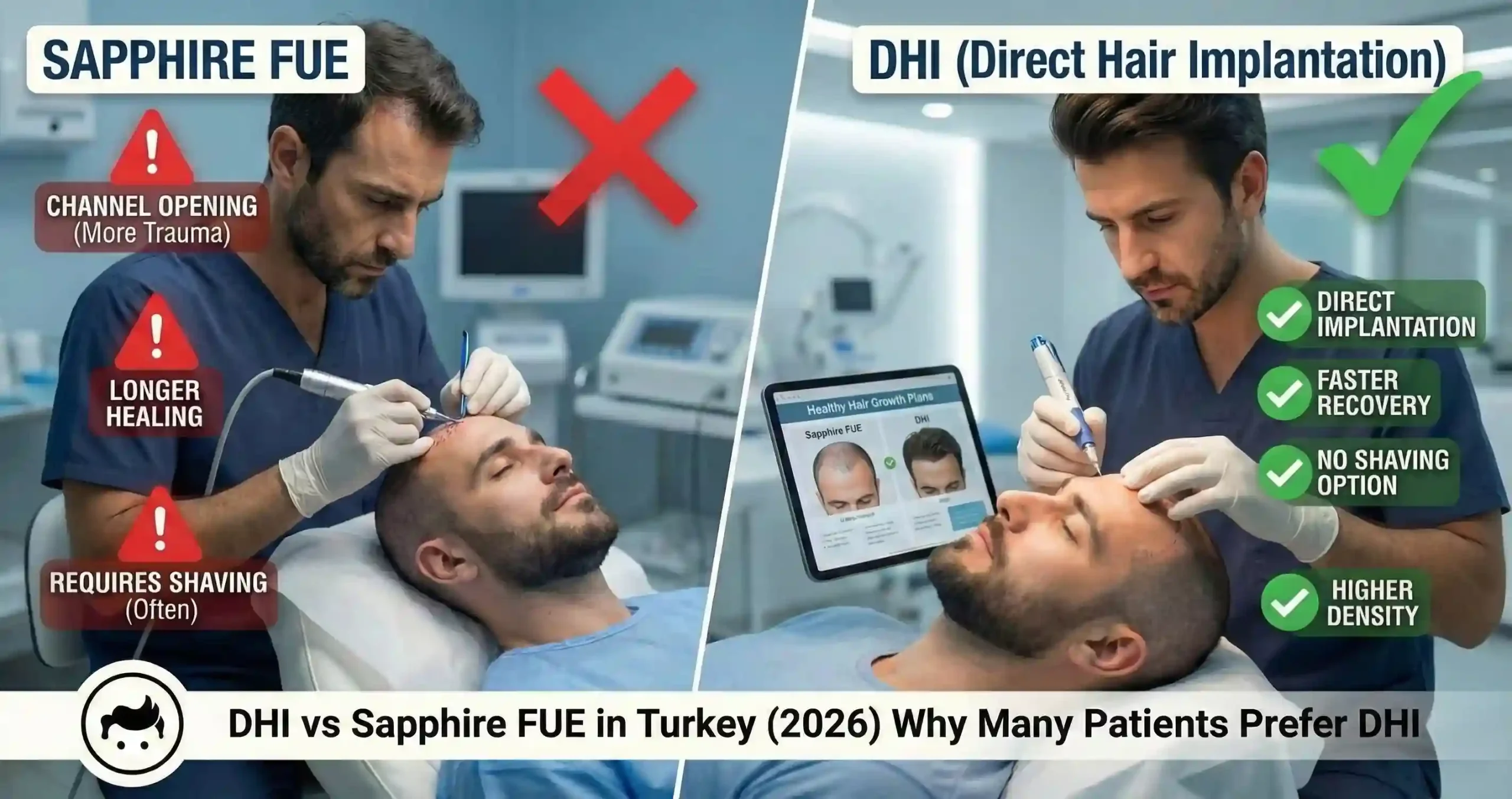

If you’re comparing DHI vs Sapphire FUE, here’s the most important clarification. While the technique is crucial for your result, most patients also carefully evaluate the hair transplant Turkey cost to understand which method fits their budget and restoration goals for 2026.
This page is a comparison hub. It won’t replace our full method pages (so it won’t compete with them). If you want the full deep guides, use:
If you are looking for transparent packages and inclusions rather than technique details, please review our Turkey hair transplant prices.
When people say Sapphire FUE, they usually mean:
So the comparison isn’t “DHI vs FUE.” It’s more accurately: DHI implantation vs Sapphire channel implantation (with FUE extraction commonly used in both workflows).
In 2026, many patients choose DHI because it often supports:
DHI is commonly preferred for patients who want a strong density effect in areas like:
Natural-looking results rely heavily on angle, direction, and distribution. Many patients choose DHI specifically because they want that “precision work” feel — especially in the front where detail matters most.
Depending on the donor and graft plan, DHI can be used beyond just “small areas.” Many clinics use DHI for broader coverage planning when the case fits.
For a complete breakdown of this method, read our detailed overview of Direct Hair Implantation (DHI) in Turkey.
Sapphire channel workflows can be a reasonable option when:
For a detailed explanation of the extraction process, check our Sapphire FUE hair transplant guide.
Many patients prefer DHI because it’s commonly chosen for:
Sapphire channel workflows can be considered depending on your plan and donor limits. The most important factor is whether the clinic can explain zone priorities and donor-safe limits.
To understand what your coverage goals require, review our Norwood scale graft estimation guide.
If a clinic pushes one method for everyone without explaining your coverage zones or the reason for the method choice, treat it as a warning sign.
To protect yourself, use our essential checklist of red flags in Turkey hair transplants.
Start by reviewing our transparent medical planning and explore our all-inclusive Turkey hair transplant packages.
Then contact our team via WhatsApp to get started.




You are just one step away from getting a completely free medical analysis.
Close windowWhich image best describes your current hair loss? Or use Voice Input.
Your age helps us determine the stability of your donor area.
At your age (18-23), hair loss is likely still progressing. We highly recommend preventative medical treatments.
Get Info on TreatmentsHave you ever had a hair transplant before?
Do you have any of the following health conditions?
Calculating graft density and hairline design.
Estimated Graft Need
🏆 Highly Recommended: VIP
We strongly recommend the VIP Package as it includes sedation/anesthesia, ensuring a completely comfortable and painless procedure.
📸 Please prepare these 3 photos for the doctor (Front Area, Top Crown, Back Donor):