

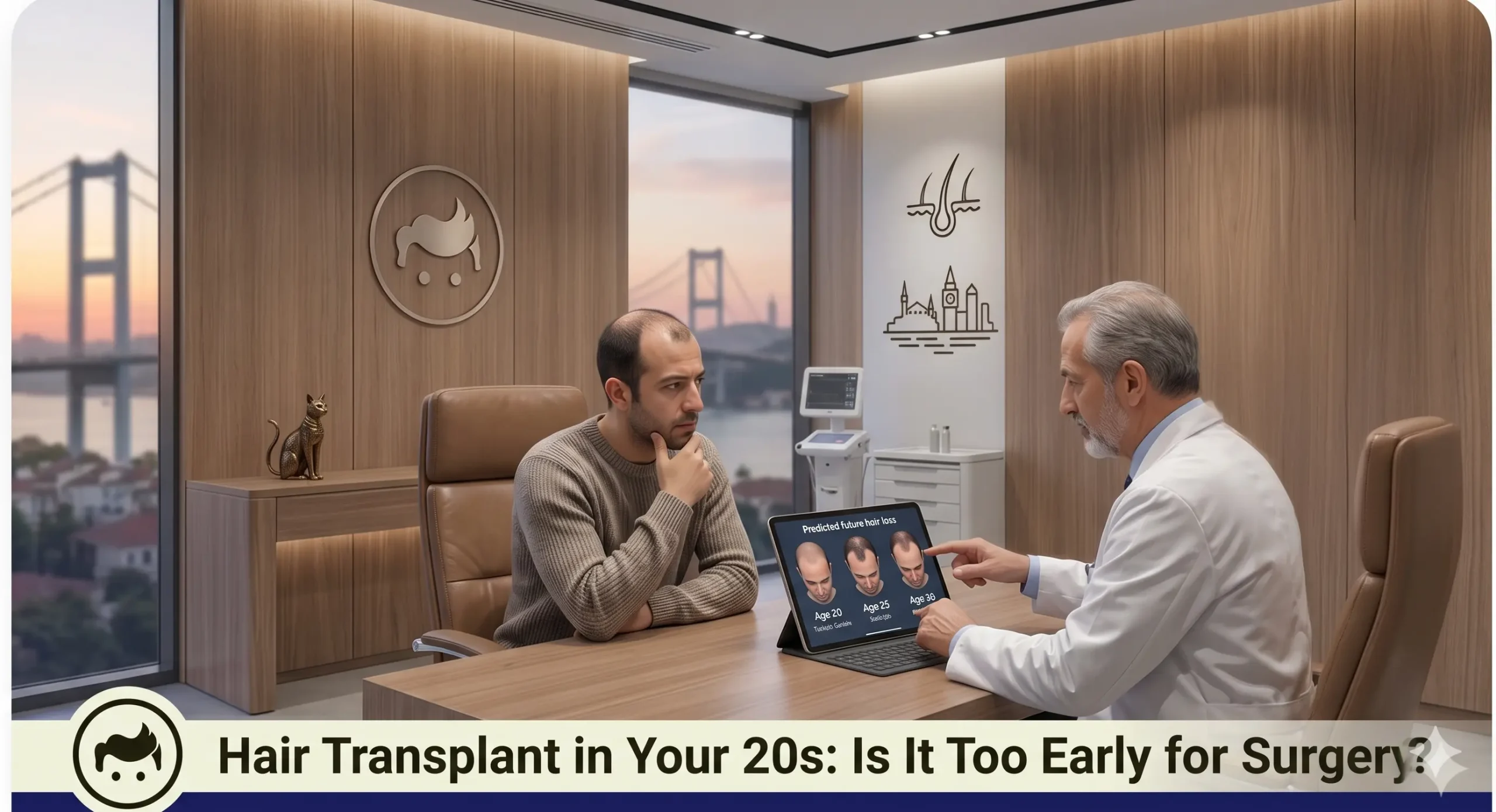

Experiencing hair loss in your early twenties can be deeply distressing, often prompting a rush to find an immediate surgical fix. However, performing surgery on a young patient presents unique medical challenges. Hair loss is a progressive condition; if treated too early without a long-term strategy, you risk depleting your donor area and leaving unnatural patches as native hair continues to fall out. When younger patients begin researching all-inclusive Turkey hair transplant packages, it is critical that they seek out a clinic prioritizing medical ethics, donor protection, and long-term planning over a quick sale. In this guide, we explain the realities of getting a hair transplant in your 20s, the criteria for candidacy, and how to protect your future appearance.
To understand why many reputable surgeons hesitate to operate on very young patients, we must first look at how male pattern baldness behaves over time.
Androgenetic alopecia, also known as genetic hair loss, does not always stop once it starts. If you begin losing hair at 21, the pattern you see in the mirror today may not be the final pattern you have at 35 or 40.
The danger of operating too early lies in chasing a receding hairline. If a surgeon aggressively lowers your hairline at age 22, and your native hair behind the transplanted area continues to shed over the next decade, you may be left with an isolated island of transplanted hair. Predicting exactly where your hair loss will stop on the Norwood Scale is difficult at a young age.
If your main concern is temple recession or an M-shaped hairline, our receding hairline transplant guide explains how frontal restoration is planned more conservatively.
Your donor area—the safe zone at the back and sides of your head—has a limited supply of healthy hair follicles. You cannot generate new donor hair.
If a young patient uses up a large portion of their donor supply to achieve a dense, low hairline in their early 20s, they may not have enough grafts left to cover the crown or mid-scalp if those areas thin later in life. Understanding how many grafts you need is not just about today; it is about reserving donor capacity for future procedures.
This is why donor area management is especially important for younger patients. A conservative first surgery can protect your long-term options better than an aggressive low hairline that uses too many grafts too early.
While caution is necessary, being in your 20s does not automatically disqualify you from surgery. A hair transplant can be considered if the following criteria are met:
For young patients, the goal is usually not to create the lowest possible hairline. The goal is to frame the face naturally while preserving enough donor supply for the future.
In the medical tourism industry, some commercial agencies may accept almost any patient regardless of age or risk—one of the major red flags to watch out for. At HWT Clinic, we operate differently.
We are not a brokerage or an agency. We are a fully licensed, 2,500 m² medical polyclinic with our own in-house doctors, surgical staff, and anesthesiology team. If a 22-year-old patient consults with us and their hair loss is too aggressive or unstable, our doctors may refuse surgery and recommend a medical management plan instead. Your safety, your donor area, and the lifelong lifespan of transplanted hair must come before short-term cosmetic goals.
If surgery is medically appropriate, younger patients usually benefit from a conservative plan using careful FUE hair transplant extraction and precise DHI hair transplant implantation when suitable. This approach helps protect the donor area while creating a natural-looking result that can age better over time.
If you are under 25 and noticing thinning, your first step should usually be medical stabilization and diagnosis, not immediate surgery. Options such as medications, PRP, or other non-surgical treatments may help slow progression, support existing hair, and delay surgery until your pattern is more predictable. You can also review our guide on proven hair loss treatments for men to understand non-surgical options before deciding on a transplant.
Age 25 is often considered a more realistic starting point for hair restoration than the early twenties, but it still requires careful medical assessment. By 25, a doctor can usually understand the trajectory of your hair loss better than at 21, but a conservative approach and ongoing medical support to protect native hair may still be recommended.
Most reputable clinics will be very cautious about performing a hair transplant at 21 because hair loss is often unpredictable at this age. Operating too early can create an unnatural appearance later if native hair continues to shed behind the transplanted grafts. In many cases, medical stabilization is recommended before surgery is considered.
It is possible. Because androgenetic alopecia is progressive, a patient who receives a transplant in their 20s may continue to lose non-transplanted hair over the next decade or two. A second procedure may be needed later, which is why preserving the donor area during the first surgery is crucial.




You are just one step away from getting a completely free medical analysis.
Close windowWhich image best describes your current hair loss? Or use Voice Input.
Your age helps us determine the stability of your donor area.
At your age (18-23), hair loss is likely still progressing. We highly recommend preventative medical treatments.
Get Info on TreatmentsHave you ever had a hair transplant before?
Do you have any of the following health conditions?
Calculating graft density and hairline design.
Estimated Graft Need
🏆 Highly Recommended: VIP
We strongly recommend the VIP Package as it includes sedation/anesthesia, ensuring a completely comfortable and painless procedure.
📸 Please prepare these 3 photos for the doctor (Front Area, Top Crown, Back Donor):